


LOLER and PUWER Regulations: 7 Key Differences Every Employer Should Know
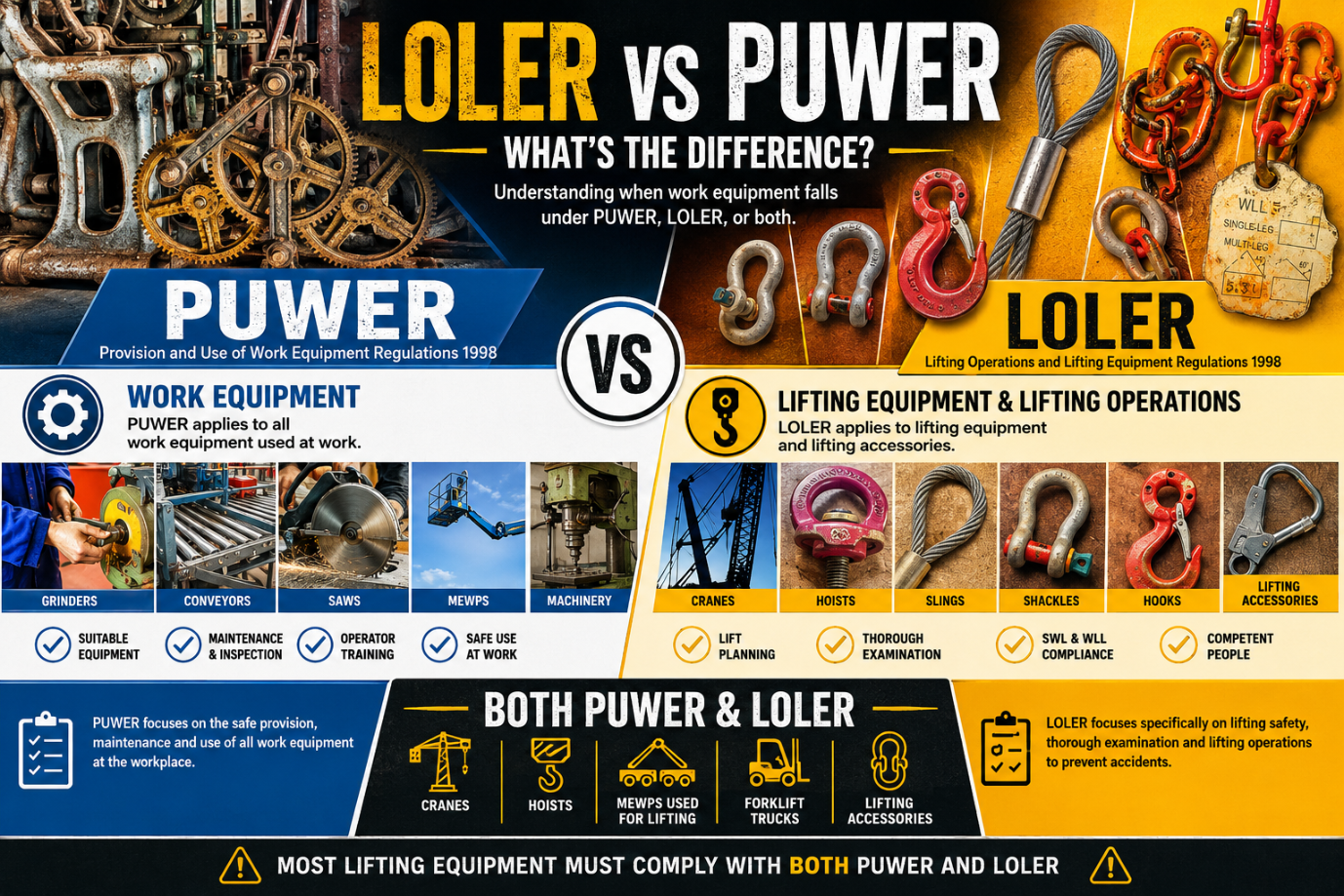
LOLER and PUWER Regulations are two important pieces of UK health and safety legislation, but what’s the difference between them, and which regulations apply to your workplace equipment?
It’s a question that can cause confusion for employers, maintenance teams and those responsible for workplace health and safety.
Both regulations play an important role in keeping workplace equipment safe, but they cover different aspects of equipment safety and inspection.
For example, did you know that a forklift truck can fall under both LOLER and PUWER Regulations, while an ordinary piece of workshop machinery may only fall under PUWER?
At Kentra Training, we’ve been helping businesses understand workplace safety and equipment training requirements since 1997.
So, let’s take a closer look at LOLER vs PUWER, what each regulation covers and why understanding the difference matters.

What Is LOLER?
LOLER stands for the Lifting Operations and Lifting Equipment Regulations 1998.
These regulations apply to lifting equipment used at work and place duties on employers and others responsible for lifting equipment and lifting operations.
LOLER requires lifting equipment to be suitable for its intended use, appropriately marked with its safe working load where required, and subject to thorough examination by a competent person at the appropriate intervals.
Lifting operations must also be properly planned, appropriately supervised and carried out safely.
Examples of equipment that may fall under LOLER include:
- Overhead cranes
- Forklift trucks
- Lorry loaders (Hiab)
- Chain blocks and lever hoists
- Lifting beams
- Slings, shackles and lifting accessories
- Mobile elevating work platforms (MEWPs)
An important point: LOLER isn’t just about large cranes and heavy machinery. Smaller lifting equipment and accessories can also be subject to its requirements.

What Is PUWER?
PUWER stands for the Provision and Use of Work Equipment Regulations 1998.
Unlike LOLER, which focuses specifically on lifting equipment and operations, PUWER covers a much broader range of equipment used at work.
This includes everything from large industrial machinery to smaller tools and equipment.
Examples include:
- Forklift trucks
- Excavators and dumpers
- Abrasive wheels and grinding equipment
- Woodworking and metalworking machinery
- Hand-held power tools
- Conveyors and production machinery
- Other workplace equipment
Under PUWER, employers must ensure equipment is suitable for its intended purpose, maintained in a safe condition and inspected where necessary.
Employees must also receive adequate information, instruction and training to use the equipment safely.

LOLER and PUWER Regulations – 7 Key Differences
Although both regulations aim to improve workplace safety, there are some important differences.
1. The Equipment They Cover
LOLER applies specifically to lifting equipment and lifting operations.
PUWER applies to work equipment more generally, including machinery, tools and equipment used by employees.
2. Their Main Purpose
LOLER focuses on ensuring lifting operations are carried out safely and that lifting equipment remains suitable and safe to use.
PUWER focuses on the suitability, safe operation, maintenance and inspection of work equipment.
3. Inspection Requirements
LOLER requires statutory thorough examinations of lifting equipment in specified circumstances.
PUWER requires inspections where equipment safety depends on installation or where deterioration or exceptional circumstances could create danger.
The type and frequency of PUWER inspections depend on the equipment and associated risks.
4. Examination Frequency
Under LOLER, where the standard statutory intervals apply, thorough examinations are generally required:
- Every 6 months – lifting accessories, such as slings and shackles.
- Every 6 months – lifting equipment used to lift people.
- Every 12 months – other lifting equipment.
Alternatively, examinations may follow a suitable examination scheme drawn up by a competent person.
PUWER does not generally specify a single inspection interval for all equipment. Inspection frequencies are determined by risk assessment, equipment condition, usage and manufacturers’ recommendations.
5. Who Can Carry Out Inspections?
LOLER thorough examinations must be carried out by a competent person with appropriate knowledge and experience of the equipment being examined.
PUWER inspections must also be carried out by someone competent for the particular inspection required.
6. Records and Reports
LOLER thorough examinations require formal written reports containing specified information, including details of relevant defects.
Under PUWER, inspection results must be recorded and retained as required by the regulations, but the reporting requirements differ from LOLER.
7. Can Both Regulations Apply to the Same Equipment?
Yes – and this is where confusion often arises!
A forklift truck is a good example of equipment covered by both regulations.
PUWER applies to the truck as work equipment, including its general condition, brakes, steering and safe operation.
LOLER introduces additional requirements relating to its lifting equipment and lifting operations, including thorough examinations where required.
Employers must consider both sets of regulations to ensure the forklift remains safe to use.

LOLER vs PUWER – At a Glance
| Requirement | LOLER | PUWER |
|---|---|---|
| Main focus | Lifting equipment and operations | General work equipment |
| Applies to | Cranes, hoists, lifting accessories and other lifting equipment | Machinery, tools, plant and workplace equipment |
| Inspection frequency | Often 6 or 12 months, or an examination scheme | Risk-based |
| Competence | Competent person for thorough examinations | Competence appropriate to the inspection |
| Records | Formal reports of thorough examination | Inspection records where required |
| Training | Competent people involved in lifting operations | Adequate information, instruction and training |
Is a LOLER Thorough Examination the Same as Routine Maintenance?
No – and this is a particularly important distinction.
A thorough examination is a detailed assessment carried out by a competent person to identify defects or deterioration that could affect the safety of lifting equipment.
Routine maintenance involves servicing, adjustments, repairs and replacing worn components to keep equipment in safe working order.
A LOLER thorough examination does not replace regular maintenance.
Equally, having equipment serviced does not automatically mean it has received the required statutory thorough examination.
Both are important parts of maintaining workplace safety.
Who Can Carry Out a LOLER Thorough Examination?
LOLER requires thorough examinations to be undertaken by a competent person.
This means someone who has the appropriate knowledge, practical experience and understanding of the particular equipment being examined.
The competent person must be able to identify defects, assess their significance and make informed decisions about the equipment’s continued safe use.
They must also be sufficiently independent and impartial.
Importantly, being trained to operate lifting equipment does not automatically qualify someone to carry out thorough examinations of it.
Specialist inspection knowledge and competence are required.
Did You Know Kentra Training Offers LOLER Inspection Training?
This is another area of our training portfolio that sometimes surprises customers!
Could your business benefit from having appropriately trained staff to inspect its own small lifting equipment and accessories?
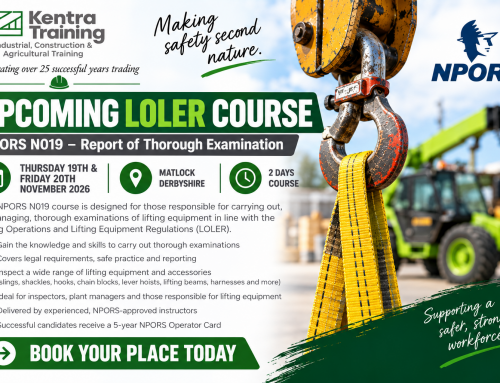
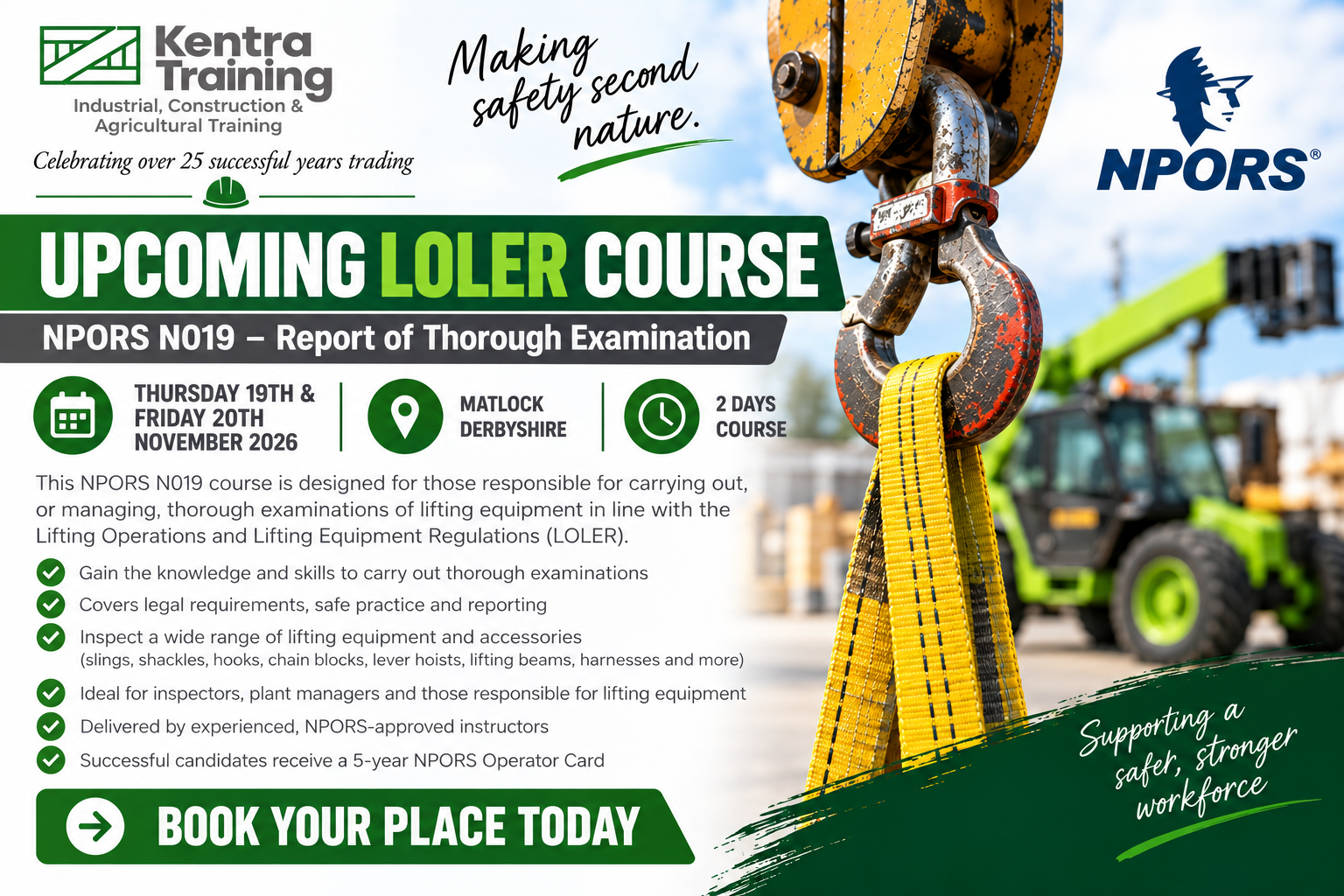
Our two-day NPORS N019 course could help you develop in-house inspection capability, subject to ensuring those undertaking examinations have the necessary competence and independence.
At Kentra Training, we offer the NPORS N019 – Report of Thorough Examination course.
Equipment and accessories covered include:
- Lifting slings and shackles
- Hooks, clamps and lifting beams
- Wire ropes and lifting accessories
- Manual chain blocks and lever hoists
- Pull-lifts and associated equipment
- Selected fall protection equipment, including harnesses and lanyards
The course combines practical inspection activities with the knowledge needed to identify defects and complete inspection documentation.
Successful candidates receive NPORS accreditation and a five-year NPORS operator ID card, confirming they have successfully completed the relevant training and assessment.
Please note: This is an inspection training course, not an instructor qualification. Completing the course supports the development of inspection competence but does not automatically establish that someone is competent to examine every type of lifting equipment.
Employers must ensure that anyone appointed to undertake thorough examinations has the necessary competence, experience and impartiality for the equipment concerned.
Find out more about our NPORS N019 Report of Thorough Examination course.

Why Understanding LOLER and PUWER Regulations Matters
Understanding the difference between LOLER and PUWER Regulations helps businesses manage equipment safety more effectively.
It can help employers:
- Identify which regulations apply to their equipment
- Arrange appropriate inspections and thorough examinations
- Maintain accurate equipment records
- Recognise when specialist inspection competence is needed
- Ensure employees receive suitable equipment training
- Reduce the risks associated with unsafe or poorly maintained equipment
Whether you’re responsible for a warehouse, engineering workshop, construction site or manufacturing facility, understanding your responsibilities is an important part of managing workplace safety.

Need Help with Workplace Equipment Training?
At Kentra Training, we provide a wide range of NPORS-accredited and in-house workplace training courses, from lifting operations and forklift trucks to small plant, machinery and health and safety.
We’ve been helping businesses train their employees since 1997, with practical training delivered at customers’ workplaces.
If you’re looking to develop your team’s knowledge of lifting equipment inspection or arrange training for your operators, we’re always happy to discuss your requirements.
Get in touch with Kentra Training:
📞 01606 832 556
For further guidance, visit the Health and Safety Executive’s official information on:
- LOLER – Lifting Operations and Lifting Equipment Regulations
- PUWER – Provision and Use of Work Equipment Regulations
Did You Know? LOLER inspection training is just one of the many courses available at Kentra Training! From forklift trucks and lifting operations to plant machinery, horticulture and health and safety, discover our full range of workplace training courses.
Kentra Training Ltd – Making Safety Second Nature Since 1997!



Leave A Comment