


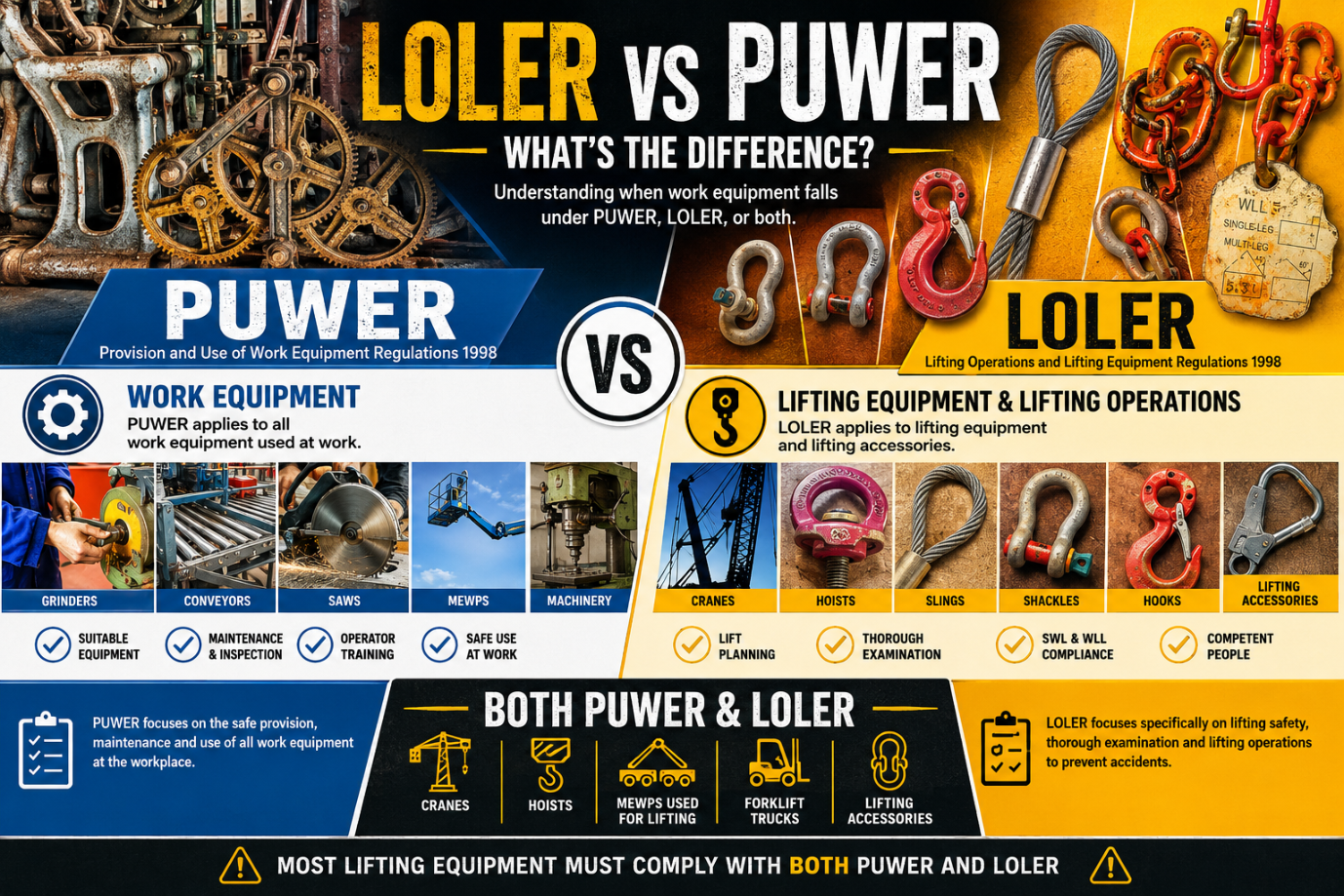
LOLER vs PUWER: What’s the Difference?
If you work with machinery, lifting equipment, or plant on construction sites, you’ve probably heard of both LOLER and PUWER. However, many employers, supervisors, and operators are unsure about the differences between these two important sets of regulations.
While LOLER and PUWER often apply to the same equipment, they focus on different aspects of workplace safety. Understanding how they work together can help employers meet their legal responsibilities, improve safety standards, and reduce the risk of accidents.
In this article, we will try to explain the key differences between LOLER and PUWER, where they overlap, and what employers need to do to remain compliant.

What Is LOLER?
LOLER stands for the Lifting Operations and Lifting Equipment Regulations 1998.
The regulations apply to lifting equipment and lifting operations carried out in the workplace.
The main aim of LOLER is to ensure that lifting equipment is:
- strong and stable enough for its intended use
- positioned and installed correctly
- used safely by competent people
- thoroughly examined at appropriate intervals
- supported by properly planned lifting operations
Examples of equipment covered by LOLER include:
- telehandlers
- cranes
- excavators used for lifting
- forklift trucks used for lifting operations
- lifting beams
- chains and slings
- shackles and lifting accessories
- MEWPs used for lifting people
LOLER focuses specifically on the risks associated with lifting loads and people.

What Is PUWER?
PUWER stands for the Provision and Use of Work Equipment Regulations 1998.
These regulations apply to virtually all work equipment used in the workplace.
The aim of PUWER is to ensure that equipment is:
- suitable for the intended task
- properly maintained
- inspected when necessary
- used by trained and competent operators
- fitted with appropriate safety devices
- accompanied by adequate information and instruction
Examples of equipment covered by PUWER include:
- excavators
- telehandlers
- dumpers
- forklifts
- agricultural machinery
- power tools
- abrasive wheels
- compressors
- woodworking machinery
PUWER focuses on the overall safety of work equipment during everyday use.

The Key Difference : LOLER Vs PUWER
The simplest way to understand the difference is:
PUWER applies to the equipment itself.
LOLER applies when that equipment is used for lifting operations.
For example, a telehandler used on a construction site will generally fall under PUWER because it is work equipment.
However, when that same telehandler is lifting a suspended load, LOLER also applies because a lifting operation is taking place.
In many situations, both regulations apply at the same time.
Where LOLER and PUWER Overlap
Many types of plant equipment are covered by both regulations.

Telehandlers
PUWER requirements include:
- operator training
- maintenance
- safety devices
- inspections
LOLER requirements include:
- lifting capacity
- lifting accessories
- thorough examinations
- planning lifting operations
Excavators Used for Lifting
Under PUWER:
- the machine must be suitable and maintained
- operators must be competent
Under LOLER:
- lifting operations must be properly planned
- lifting accessories must be examined
- lifting equipment must undergo thorough examination

Forklift Trucks
Forklift trucks are covered by PUWER during normal operation.
Where lifting operations are carried out, LOLER may also apply depending on the activity being undertaken.

Employer Responsibilities Under PUWER
Employers must ensure that work equipment is:
Suitable
Equipment must be appropriate for the task and operating environment.
Maintained
Maintenance programmes should help keep equipment in a safe condition.
Inspected
Inspections should be carried out where deterioration could create risks.
Used by Competent People
Operators should receive adequate information, instruction, and training.
Protected by Safety Measures
Equipment should have suitable guards, warning systems, and safety devices where required.

Employer Responsibilities Under LOLER
LOLER places additional duties on employers involved in lifting operations.
These include:
Thorough Examination
Lifting equipment must be examined by a competent person at appropriate intervals.
Planning
Lifting operations should be properly planned and organised.
Supervision
Lifting activities should be adequately supervised.
Safe Working Loads
Equipment must never be used beyond its safe working limits.
Suitable Lifting Accessories
Chains, slings, hooks, and other accessories must be suitable and maintained.

Common Compliance Mistakes
Many organisations unknowingly focus on one regulation while overlooking the other.
Common examples include:
- carrying out maintenance but neglecting thorough examinations
- training operators but failing to plan lifting operations
- inspecting machinery but ignoring lifting accessories
- relying solely on daily checks instead of formal examinations
- misunderstanding when LOLER applies
A compliant workplace needs to consider both regulations together.

Why Training Matters
Training plays a vital role in helping employers and operators understand their responsibilities under LOLER and PUWER.
Effective training can help:
- improve operator competence
- reduce workplace accidents
- identify hazards earlier
- improve compliance
- support safer lifting operations
Regular refresher training can also help reinforce safe working practices and prevent complacency from developing over time.
Frequently Asked Questions – LOLER vs PUWER
Which regulation came first?
Both LOLER and PUWER came into force in 1998 as part of wider workplace safety legislation.
Does a telehandler fall under LOLER or PUWER?
Usually both.
PUWER applies because it is work equipment, while LOLER applies when lifting operations are carried out.
Do daily checks satisfy LOLER requirements?
No.
Daily checks are important, but they do not replace the requirement for a thorough examination by a competent person.
What is a thorough examination?
A thorough examination is a detailed inspection of lifting equipment carried out by a competent person to identify defects that could affect safety.
Final Thoughts
LOLER and PUWER are closely linked regulations that help ensure equipment is used safely in the workplace.
While PUWER focuses on the suitability, maintenance, and safe use of work equipment, LOLER addresses the additional risks associated with lifting operations.
Understanding the difference between the two can help employers improve compliance, reduce risk, and maintain safer working environments.
For organisations involved in lifting operations, ensuring that both LOLER and PUWER requirements are met is an essential part of effective health and safety management.

👉 Get in touch with us today to discuss how we can support your organisation with compliant, effective operator training and dealing with LOLER vs PUWER
📞 Call us on 01606 832 556 or visit www.kentratraining.co.uk to arrange your course.
Kentra Training – Our Mission : Making safety second nature.
Thank you for reading our blog about LOLER vs PUWER: What’s the Difference? for more details you can also check out our other blogs:
N019 Official NPORS Report Of Thorough Examination Training
Report of Thorough Examination – our A 2 Z of Safety Training
N019 Report of Thorough Examination Course Details
NPORS Report of Thorough Examination
Our awarding body is National Plant Operators Registration Scheme – NPORS.com


Leave A Comment